Recently, I ended my ePub-a-Dub-Dub article with a question: “How’s that for a crazy, upside-down world?” I asked. Though meant rhetorically, it prompted a hint of genuine self-curiosity. Why do I always believe the world is upside-down? I know plenty of people who think it’s A-OK just the way it is. There must be some explanation; some viable theory? I filed the question in my mental “To Do” list of existential problems that I’ll likely never solve, then carried on with my daily business.
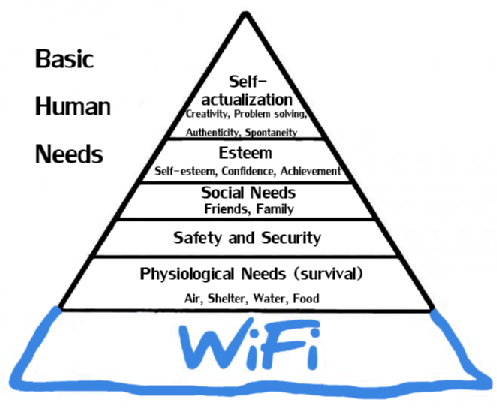
A couple days ago, while chasing down some unrelated snippet of trivia, I stumbled across a Maslow’s Hierarchy of Needs diagram. Anyone who’s ever been subjected to an introductory psychology class has had this old chestnut foisted upon them.

For the benefit of all who skipped class on Maslow day, I’ll provide a brief overview. In the early 1940’s, Abraham Maslow devised a theory that the human condition has a pre-defined set of needs, and that humans go about satisfying these needs in a certain order — from the bottom up. Maslow theorized that humans must satisfy one set of needs before they can address the next set, creating a foundation upon which ever-more psychologically complex needs reveal themselves.
In Maslow’s model, humans have a primal instinct to first satisfy certain physiological requirements, like food and water, before worrying about much else. Once their physiological needs are met, people become more concerned with safety and security issues — issues that are, in turn, more urgent than the next hierarchy of needs: love & belonging. According to Maslow, once humans have food, water, a job, a home, good health, family, friends and sexual intimacy, they can then go about satisfying their need to be respected and appreciated. Finally, once they’ve gained the respect of their peers and colleagues, they can begin their quest for the ultimate need — the need for self-actualization and the knowledge that one has achieved their full potential as a human being.
Maslow’s pyramid implies that human motivation always builds upon a balanced foundation of needs, and that we’re each distinguished by how high we’ve managed to build our pyramid of sated demands. But like most “catch all” theories involving human existence, Maslow’s has one fatal flaw — it doesn’t “catch” me. In fact, it utterly fails to define the seemingly haphazard way in which my own needs structure has evolved — a structure that looks something like this:

Sadly, I’m not the only person with a needs structure that’s more “shanty” than “pyramid.” In fact, I’ve know people whose needs structures aren’t even “structures” at all — they’re demolition sites.
Unlike Maslow, I don’t profess to have insight into all human motivations, but I do know a little something about the needs of creative people. Mind you, when I use the term “creative people,” I’m not talking about someone who takes a pottery class at the local community center. I’m talking about people who are compulsively driven to create something that will change the world — or, at least, change that one little piece of the world that interests them. This person could be a composer, a writer, a scientist, or even a photographer. These people, who I’ll refer to simply as “creatives,” have needs structures that appear to totally invalidate Maslow’s theory.
For creatives, it’s as if Maslow doesn’t exist. Everything in the creative’s world is sacrificed for the pinnacle of the pyramid — self-actualization. But Maslow’s model dictates that people can only be interested in higher-level needs once their lower-level needs are satisfied.
As I looked at the standard Maslow diagram, the question that began this article entered my head: “Why do I always believe the world is upside-down?”
On a whim, I turned Maslow’s needs pyramid upside-down — and that’s when I saw it: The creative person’s hierarchy of needs was simply an inverted Maslow pyramid!
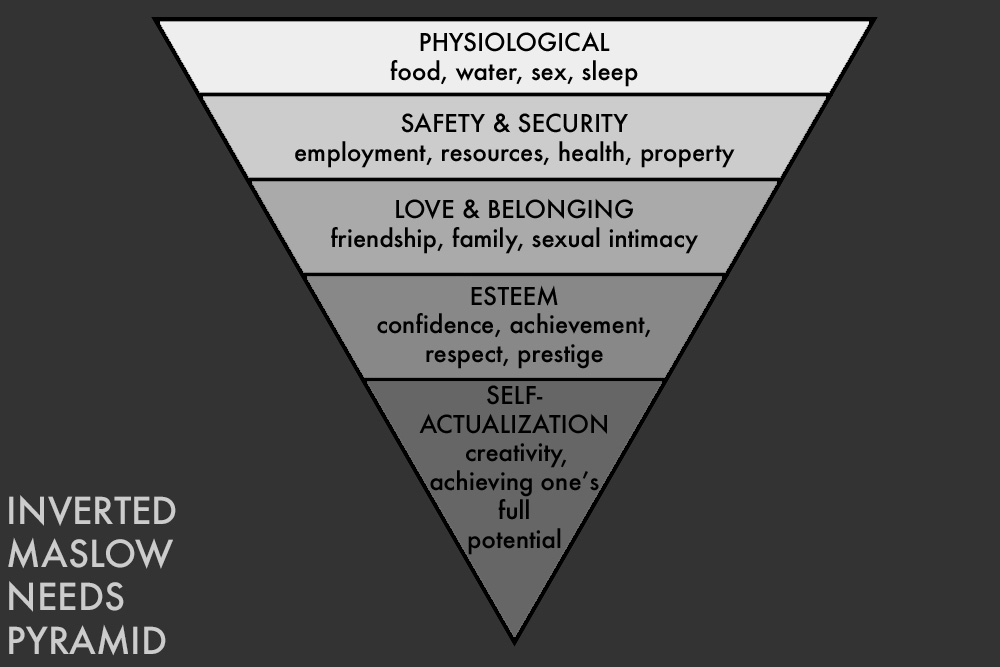
It all made sense. Maslow’s theory that one must satisfy a lower-level need before addressing an upper-level need is actually sound — it’s just that he got the order inverted for creatives. Self-Actualization is the fundamental need that drives all creatives. It is, in many ways, their most basic need. Of course, once they’ve satisfied their own creative mandates, creatives want others to know and appreciate what they’ve done. Esteem is thus something that can be sought only after a creative has satisfied himself. And though many creatives long for intimate relationships, they’re rarely able or willing to put the time and energy into making them work — love simply takes too much time away from the process of creating. Thus, establishing intimate and meaningful relationships is something many creatives can do only after achieving a certain measure of self-actualization and esteem. Finally, many creatives seem to view their own safety, security and physiological needs with a sort of “disdain” — as if the act of assuaging them (or the effort spent in trying) is so pedestrian, banal and trite that their fulfillment is tantamount to “selling out.” Only the most successful, respected and loved creatives ever seem to achieve the top echelon of the inverted Maslow Pyramid.
Not only does the inverted Maslow do an excellent job of explaining the motivations of creative individuals, but it also indicates why creative people are often more fragile and unstable. Just look at that structure. The entire thing — a creative’s entire existence — balances on a single point. Unless those needs situated above self-actualization are met with the utmost care and balance, the whole pyramid tips over on its side.
All these years I thought Maslow was a crock. Turns out I was wrong. I was just looking at it upside-down. Typical.


ABOUT THESE PHOTOS: Yes, indeed, they’re all photos of steps. What can I say? I’m a sucker for symbolism. “Into the Light” was shot with a Leica M9 and a 28mm Summicron. “Pyramidal” was shot with a Leica M9 and a 1982 v4 35mm Summicron. “Ascent to Nowhere” was shot with a Ricoh GXR using a 50mm A12 lens module. “Descent to Nowhere” was shot with a Leica M Monochrom and a 35mm Summilux-M lens. No shutters were activated in the creation of the three Maslow Needs Pyramids, which I created by sprinkling a bit of mirth on a Photoshopped amalgamation of various existing illustrations.
If you find these photos enjoyable or the articles beneficial, please consider making a DONATION to this site’s continuing evolution. As you’ve likely realized, ULTRAsomething is not an aggregator site — serious time and effort go into developing the original content contained within these virtual walls.